The Council of Education's
Night College of Arts and Commerce, Kolhapur
Estabilshment in 1971 | Affiliated to Shivaji University, Kolhapur | NAAC reaccredited 'A' grade
The Council of Education's
Night College of Arts and Commerce, Kolhapur
Estabilshment in 1971 | Affiliated to Shivaji University, Kolhapur | NAAC reaccredited 'A' grade
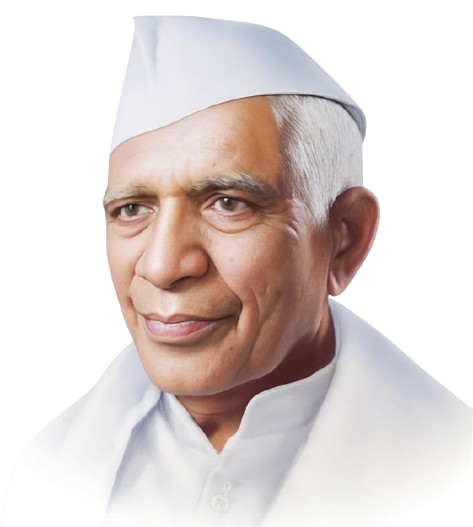
Great Freedom Fighter Deshbhakt Padmashri Dr. Ratnappanna Kumbhar stands as a towering figure in India’s freedom struggle and the making of modern Maharashtra. Born on September 15, 1909, at Nimshirgaon to Bharmappa and Gangubai, he dedicated his life to the service of the nation and the upliftment of the masses.
Driven by the fire of patriotism, Hon. Ratnappanna Kumbhar left his legal studies unfinished to join the 'Praja Parishad' movement. In 1939, he founded the Praja Parishad to demand civil rights and responsible governance from the Kolhapur Princely State. As a skilled organizer and Secretary of the Parishad, he turned it into a mass movement that reached every village. During the Quit India Movement, he led a revolutionary struggle while remaining underground for five consecutive years (1942–1947).
After the independence, 22 princely states in Maharashtra were merged into the Indian Union under the resolute leadership of Deshbhakt Ratnappanna Kumbhar. This historic feat earned him the title "Iron Man of the South." As a member of the Constituent Assembly of India, he holds the distinct honor of being a signatory to the Original Constitution of India. He served as a member of the first Lok Sabha (1952–57) and was elected to the Maharashtra Legislative Assembly six times from the Shirol constituency. As a Cabinet Minister (1974–1978), he handled key portfolios like Home, Food & Civil Supplies, and Urban Development with impeccable efficiency.
A pioneer of the Green Revolution in Kolhapur, Ratnappanna emphasized agro-economics for rural development. In 1955, he established the Panchganga Sahakari Sakhar Karkhana, which transformed the socio-economic landscape of the region. He initiated the Nimshirgaon Lift Irrigation Scheme, the largest of its kind in the country, to turn arid lands into fertile belts. In 1963, he started 'Janata Bazaar', a cooperative consumer store that grew to 49 branches. In 1965, he founded India’s first joint cooperative spinning mill for farmers and weavers at Ichalkaranji. He also accelerated industrialization by establishing the People’s Co-operative Bank.
Believing that quality higher education is the key to social progress, he founded 'The Council of Education' in 1951. Under this umbrella, he established Shahaji Law College, Commerce College, and the Night College, providing a platform for academic excellence in Western Maharashtra. His work through the Dadasaheb Magdum Memorial Committee, Balwadis (nurseries), and the library movement significantly boosted literacy and educational awareness among masses.
A staunch Gandhian with a charismatic personality, Ratnappanna was known for his simple living and profound vision. He was a master communicator who maintained personal ties with everyone, from students to Prime Ministers, through thousands of letters. His statesmanship, mastery over diverse subjects, and deep-rooted commitment to public welfare set a benchmark in work culture across various fields.
In recognition of his extraordinary contribution to society, the Government of India honored him with the 'Padmashri'. He was also awarded an honorary D.Litt. by Pune University and a Citation of Honor by the Kolhapur Municipal Corporation.
This legendary leader, an effective orator, and a true champion of the masses breathed his last on December 23, 1998. His legacy continues to inspire the Council of Education and every student who passes through its portals.
